
Brown County Police Blotter Sources
Official options come up empty here. The sheriff's office posts no 72-hour, weekly, or other multi-day arrest blotter. Brown County's current roster address shows only a scam-related removal notice. New Ulm, Sleepy Eye, and Springfield police pages offer no live name-and-booking feed either, so treat any newspaper or private database as incomplete coverage. The best secondary source is The Journal police-log index. It publishes frequent, daily-looking reports drawn from local police and sheriff records. Entries use short text summaries. Some name the agency, a person's approximate age and city, an alleged offense, and whether a citation or arrest occurred. Others note transport to Brown County Jail. None of the examples includes a mugshot gallery.
Read Brown County Arrest Reports
Read blotter posts backward by publication date, then check them against official records. News time is not arrest time. One post can mix several agencies or days. A later entry may describe an earlier event. Pagination helps a broad review, but the publisher controls archive depth.
- Open The Journal's police-log index and begin with the newest dated post.
- Read the item for the named agency, event date, city, and whether it says cited, arrested, or transported.
- Continue through earlier pages to cover the desired multi-day period. Do not assume a missing item means no police action occurred.
- For present custody, contact Brown County Jail or try the VINELink Custody Check.
- For a same-day question, use the Arrests Last 24 Hours fallback chain. For the legal outcome, check the Minnesota court record.
A representative Journal police-log entry shows how brief local summaries are presented.
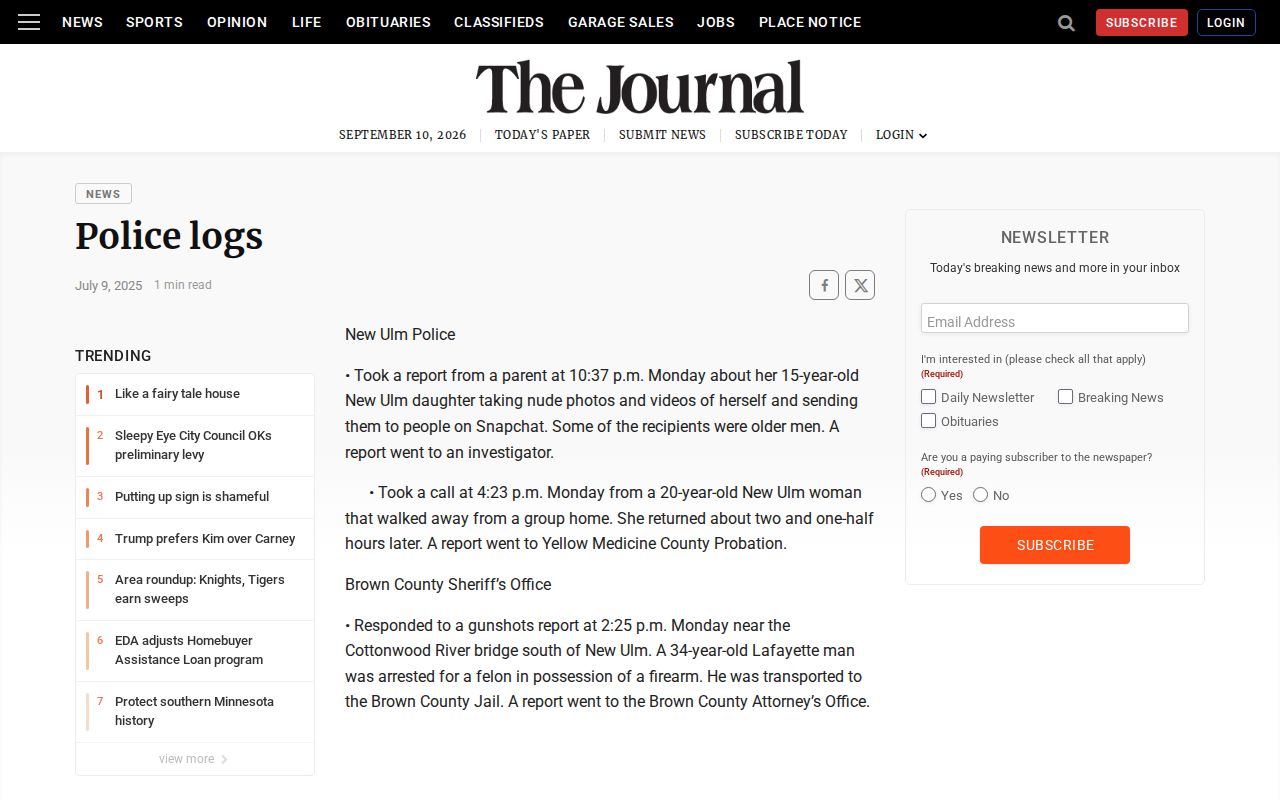
The newspaper's police-log page shows its reporting format, not a live custody search.
Brown County Blotter Entry Fields
News entries skip the county's historic roster fields. They summarize police activity in prose instead. A line may identify an event yet leave out the booking number, bail, photograph, or exact custody status. So read each word literally. "Transported to Brown County Jail" differs from "cited," and neither phrase tells you where a person is days later.
| News detail | What it can and cannot establish |
|---|---|
| Agency | Identifies the reporting law-enforcement body, not always the jail custodian |
| Age and city | Helps distinguish an item but is not a full identity match |
| Alleged offense | Describes an charge, not a conviction or final charge |
| Cited or arrested | Reports an action; it does not prove current custody |
| Transport to jail | Shows an intake destination at that time, not later release status |
| Publication date | Marks when news was posted, not necessarily when the event occurred |
An official arrest record can hold public data listed in Minnesota Statute section 13.82: arrest time, place, legal basis, agency, custody location, and release information. The newspaper is not required to reproduce every field. A court docket records the later case. It tracks what happened after the arrest.
Weekend Brown County Arrest Coverage
Weekends and holidays complicate blotter reading. Police activity and publication run on different clocks. Brown County publishes no official weekend posting schedule. The Journal may group, delay, select, or drop reports to fit its news cycle. A Monday or Tuesday post can describe an earlier event. That is not a measured surge in bookings. Don't count headlines as a complete arrest total. One police-log item may be a citation with no jail booking. Another may say someone was transported to Brown County Jail. A third agency event may never reach the newspaper. The county jail also holds people awaiting trial or sentence, serving short terms, awaiting Minnesota DOC transfer, or held on another jurisdiction's warrant. Those groups extend well past any weekend blotter.
The police-log landing page is the best starting point for its latest pagination.
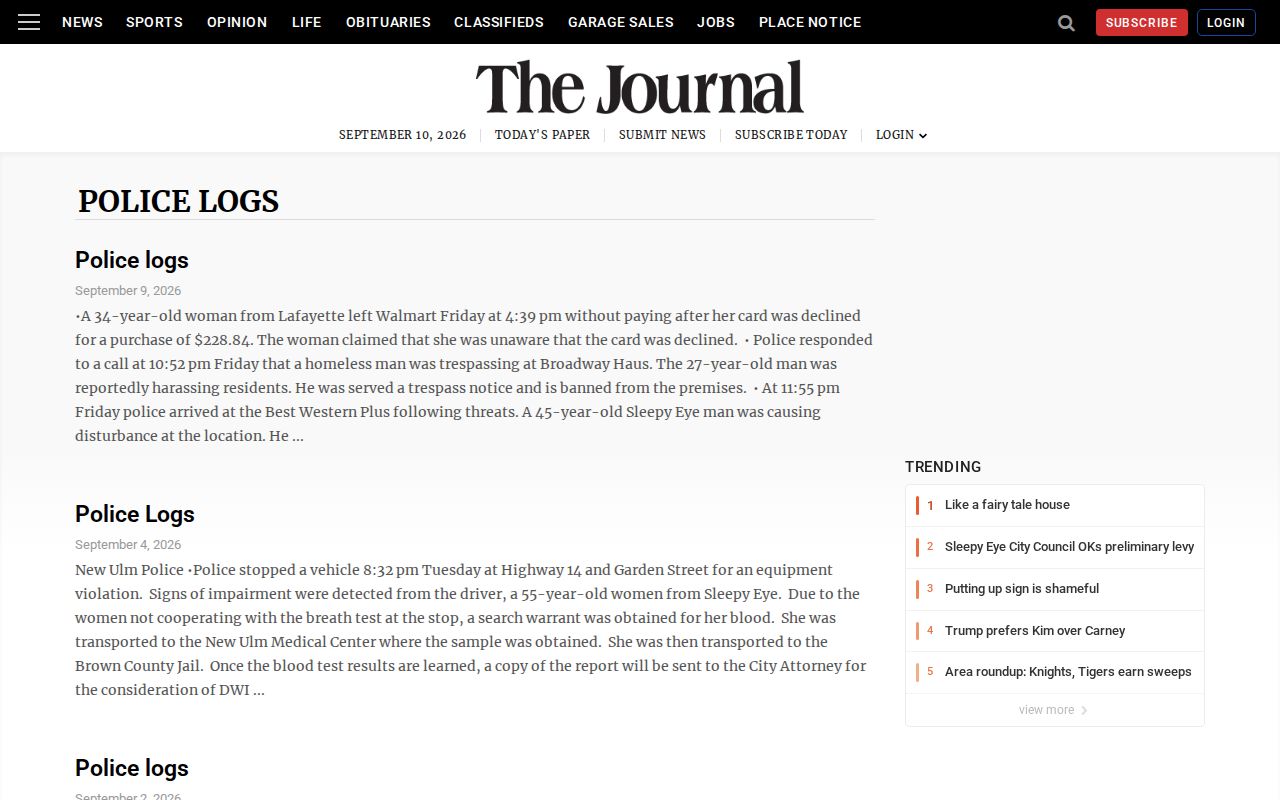
This index supports a multi-day reading workflow, while official offices remain the verification source.
Brown County Arrest Log Archives
How long do old booking photos last? Brown County publishes no exact retention period for them. That goes for roster rows and arrest images too. A vanished web page does not mean the agency record was destroyed. Minnesota records-management guidance requires official records to follow an approved retention schedule. County custody records run on the county schedule. A newspaper's pagination has nothing to do with it. For an old booking, ask the Sheriff's Office data-practices custodian whether the record still exists. Ask also which schedule series controls it, and whether the photo belongs to the arrest record or the jail record. Give the agency a date range and a record type. Add a case or report number when known. City police made the arrest? Ask that department about its own record series. A newspaper archive can preserve a report while the government file sits elsewhere. The Minnesota State Archives collects historically valuable government records. It is not a routine destination for Brown County booking photos. So don't assume a missing roster row was transferred there. The county records officer is the first stop for custody-file retention.
News Versus Brown County Custody
News coverage and official custody records answer different questions about the same event. A newspaper story can tell you an agency reported action on a certain night. That person may not sit in a Brown County cell right now. Custody is a separate matter for the jail. VINE handles custody notifications when a matching record exists. Minnesota Court Records Online carries the later docket. Pending cases usually require a case number or a courthouse terminal rather than a defendant-name search.
Sleepy Eye Online adds local color. The reports often touch on arrests. Treat it as a supplement. The Herald-Dispatch covers the area as well, but it runs no dedicated arrest section. Either way, news reporting complements the official channels rather than replacing them.
Aggregator sites sometimes post booking photos, filters, and dates for Brown County. None of that is official. The data can be stale, thin, or flat wrong. A listing there says nothing about who is actually in custody. For anything that matters, rely on the jail, the court, and the sheriff instead.
Confirm Brown County Arrest Outcomes
A booking entry only shows the charge logged when someone was arrested. That count can change. Prosecutors drop counts, add new ones, or resolve a case through a plea. The Brown County recent arrests hub connects each arrest item to the right court. Records-request paths sit there too.
- Blotter
- A selected account of police activity, often prepared by a news outlet.
- Booking
- The jail's intake process after an arrest.
- Disposition
- The court's later resolution of a case.
- Retention
- The approved period and rules governing how an agency keeps a record.
Don't confuse the event date with the publication date. A news story may run days after the arrest happened. Before tying two Brown County records to one person, check the name spelling, the arresting agency, and the case number, since common names or a bare age-and-city detail make mix-ups easy.
Public Record Search
Sponsored Results